
Referring Providers
BIDMC welcomes physician referrals and the opportunity to provide excellent care for your patients.

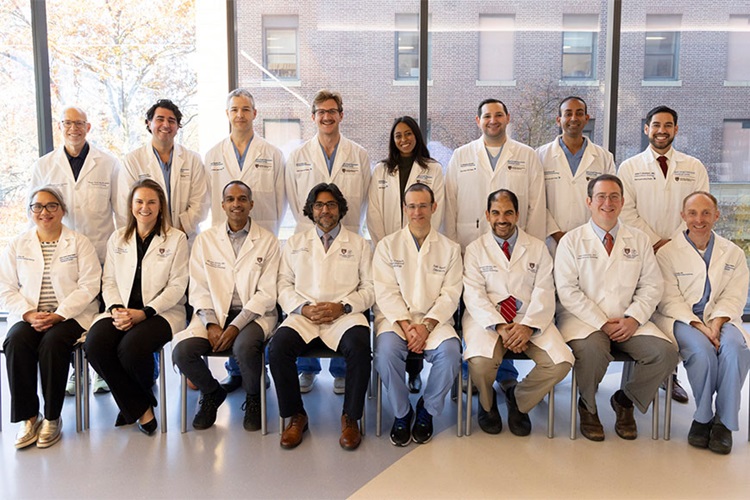
The Division of Vascular & Interventional Radiology has a busy practice (with approximately 9,000 diagnostic and interventional procedures performed each year) supported by 12 full-time, fellowship-trained IR attending physicians. Our VIR physicians perform a wide range of IR procedures, across multiple imaging modalities (both vascular and non-vascular interventions using both fluoroscopy and cross-sectional imaging).
We pride ourselves on building strong collaborative relationships with other physician specialists within BIDMC and its affiliates and strive to provide the best patient care and clinical service possible. In addition to our service offerings, we also help shape the future of interventional radiology through our hands-on education programs and innovative research activities.
We specialize in treating a wide range of medical conditions through the use of minimally invasive diagnostic and therapeutic procedures using advanced imaging such as fluoroscopy, CT, ultrasound and MRI.
These procedures often involve lower risk, less pain and a shorter recovery time than open surgeries. Our interventional radiologists are global leaders in the field, have set new clinical standards, such as for prostate artery embolization, and have been recognized for outstanding care, medical education and research.
In addition to IR physicians, there are 9 non-procedural advanced practice PA/NPs who manage the outpatient care of our IR patients. The IR practice is also supported by a large group of very competent IR nurses and technologists.
We collaborate with top medical organizations and have received funding from institutes including the National Institutes of Health, the National Cancer Institute, the Radiological Society of North America and the Society of Interventional Radiology (SIR).
Areas of expertise include:
Additionally, many of our VIR faculty members have been recognized and awarded for their work, including two recipients of the Gary J. Becker Young Investigator Award, the highest honor awarded by the Society of Interventional Radiology to early-career interventional radiologists.
The main hospital-based facility has a total of 5 available procedural suites. This includes: 3 state-of-the-art angiography suites on the West Campus, in the brand new Klarman Building that opened in March 2023.
These suites all include high-resolution digital subtraction angiography, rotational angiography, cone-beam CT, and workstation-based volume-rendered imaging with reconstructions. All rooms have dedicated Interventional Radiology ultrasound equipment.
On the East Campus, an advanced angiographic suite, with a new holding area, break room and reading room opened in 2016. A new fluoroscopy room capable of cone-beam CT opened in the summer of 2022. This is where many procedures ranging in complexity are performed, including superficial venous disease interventions. Additionally, CT-guided procedures are performed in state-of-the-art procedural CT scanners on both the East and West Campuses.
Interventional Radiology has two dedicated complete outpatient IR clinic rooms, complete with examination tables computers and physical exam equipment, on the West Campus close to the IR procedural area. In addition, IR physicians are an integral part of both the Liver Tumor Multidisciplinary Clinic and the Lung Tumor Multidisciplinary Clinic.
The VIR division has a very busy advanced hepatobiliary practice (including biliary drainages, cholangioplasty, metallic stenting, biopsy and management of biliary leaks) and collaborates closely with the advanced endoscopy group at BIDMC (which maintains the region’s largest ERCP/EUS practice) and the Pancreatic Cancer Center.
The VIR division performs a wide range of general arterial and venous interventions, including IVC filter placement and retrieval (including complex embedded filters), treatment of DVT (thrombolysis, angioplasty, and stenting), treatment of arterial and venous stenosis (angioplasty and stenting), and treatment of arterial bleeding (such as traumatic and gastrointestinal bleeding).
VIR physicians also treat pulmonary AVMs, perform bronchial artery embolizations and sclerotherapy of adult venous malformations.
VIR physicians also staff the cross-sectional VIR physician rotation during which they perform routine CT- and US-guided biopsies and drainages (in the chest, abdomen, and pelvis), as well as image-guided palliative pain therapies including celiac plexus neurolysis.
The VIR division has a busy endocrine-related practice, including performing adrenal vein sampling, ectopic parathyroid angiography and embolization, and benign adrenal adenoma ablation. BIDMC is one of the world’s leading center for minimally invasive treatment of hormonally active benign adrenal tumors.
VIR physicians routinely place percutaneous feeding tubes, including primary gastrostomy, gastrojejunostomy and jejunostomy tube placement and their subsequent management.
Through our partnership with transplant surgery and nephrology, VIR physicians perform procedures at the hospital-affiliated outpatient Advanced Vascular Care (AV Care) center, which focuses on managing hemodialysis access care for patients from several different outpatient dialysis centers.
This includes tunneled catheter placement/removal, fistulograms, balloon angioplasty, stenting, mechanical thrombectomy/thrombolysis, and venograms. The BIDMC hospital VIR practice also performs fistula and dialysis interventions on inpatients and those cases that require higher levels of care.
Our VIR physicians work closely with our Liver Transplant Center and as key participants in BIDMC’s Liver Tumor Board/Clinic, and perform advanced hepatic interventions including transjugular intrahepatic portosystemic shunts and associated procedures (TIPS/BRTO), post-transplant interventions (arterial and venous angioplasty/stenting) and liver biopsies (percutaneous and transjugular).
The VIR division also has an active Interventional Oncology practice – performing transarterial chemoembolization (with conventional lipiodol and drug-eluting beads) for primary and secondary liver tumors, radioembolization, and CT/US-guided tumor ablation of liver, kidney, lung, bone, adrenal and soft tissue tumors using various ablation technologies (radiofrequency, microwave systems, and cryoablation).
VIR also works with 4 other medical specialties in a multidisciplinary single-site liver cancer clinic.
The VIR group has a robust clinical practice in prostate artery embolization, pelvic angiography for the evaluation and treatment of erectile dysfunction and varicocele treatment for infertility or pain.
We routinely perform transradial arteriography for interventions including radioembolization, chemoembolization and uterine fibroid embolization.
VIR physicians also perform image-guided treatments for pain, such as facet joint injections and kyphoplasty/sacroplasty.
At an offsite outpatient center, the VIR division has a comprehensive practice performing patient consults and treating lower extremity superficial venous disease using sclerotherapy and endovenous ablation.
The VIR division performs percutaneous nephrostomies (and nephroureteral stents) and suprapubic catheter placement for acute urinary obstruction, as well as for lithotripsy guidance in the management of urinary stone disease.
The VIR division has an active role in gynecologic interventions, including embolization for the elective treatment of uterine fibroids, pelvic congestion syndrome, and for the emergent treatment of uncontrolled postpartum hemorrhage. We also perform fallopian tube recanalization procedures.
We are committed to training the next generation of Interventional Radiologists. We offer a variety of educational and training opportunities to medical students, residents, fellows, post-doctoral fellows and physicians-in-training, including:
Learn more about our BIDMC Interventional Radiology training programs.
Our division comprises award-winning doctors and medical experts who have made us world leaders in the field of IR research.
Our accomplished IR faculty is responsible for multiple research developments, including:
Learn more about our Interventional Radiology research programs.

BIDMC welcomes physician referrals and the opportunity to provide excellent care for your patients.


