BIDMC Offers Minimally Invasive Procedure for Patients with Testicular Cancer
Robotic Surgery Expands Treatment Options for Testicular Cancer
Patients with testicular cancer can benefit greatly from a type of minimally invasive procedure known as Retroperitoneal Lymph Node Dissection (RPLND).
RPLND involves removing the lymph nodes in the back of the abdomen. For certain patients, this robotic surgical approach not only provides an effective cure for testicular cancer, it can also shorten recovery times.
Patients can take advantage of RPLND through Beth Israel Deaconess Medical Center’s (BIDMC) Division of Urologic Surgery.
What Is RPLND?
According to Dr. Peter Chang, a urologic surgeon at BIDMC, testicular cancer has a predictable pattern of metastasis. “Germ cell tumors of the testis, if they’re going to spread, will almost always first spread to the retroperitoneum,” Dr. Chang says.
The retroperitoneum encompasses the back of the abdomen, including the adrenal glands, kidneys, pancreas and parts of the stomach and colon. It also includes the aorta and the vena cava, the two largest blood vessels in the body, which extend from the chest to the pelvis. These two vessels are coated with lymph nodes, which are integral to the immune system.
Small and beanlike in structure, lymph nodes are part of the lymphatic system that helps the body fight infection and disease, including cancer. However, cancer cells can often become trapped in lymph nodes, suppressing their immune response and allowing cancer tumors to further metastasize.
If a case of testicular cancer spreads to the retroperitoneum, the lymph nodes will likely be affected by the cancer, Dr. Chang explains. An RPLND procedure specifically involves removing the lymph nodes within the fatty tissue surrounding the aorta and vena cava. The goal of this procedure is two-fold, to determine if the cancer has spread to the lymph nodes, and if it has, to effectively cure the patient by removing them.
Who Benefits From RPLND?
RPLND is not part of the typical treatment plan for patients with testicular cancer; it’s usually reserved for those with a higher risk of recurrent or residual cancer after radical orchiectomy (testicle removal), Dr. Chang says.
According to Dr. David Einstein, a genitourinary medical oncologist at BIDMC, there are three typical use cases for recommending this procedure:
- A testicular cancer has been completely removed in the testicle, and RPLND is used to make sure there is no spread to the lymph nodes;
- A testicular cancer has spread to the lymph nodes but is still fairly limited, and RPLND offers an alternative to chemotherapy, or;
- A testicular cancer has spread to the lymph nodes and is treated with chemotherapy, but the response is incomplete.
At BIDMC, a multidisciplinary care team consisting of oncologists, urologists, surgeons and other specialists will assess testicular cancer cases at a weekly tumor board and ultimately determine which patients will benefit from RPLND.
Open vs. Robotic Surgery
Traditionally, RPLND is performed as an open surgery, involving an incision from the breastbone to the pelvic bone. Surgery of this magnitude often requires a hospital stay of 2-4 days and a significant perioperative recovery protocol.
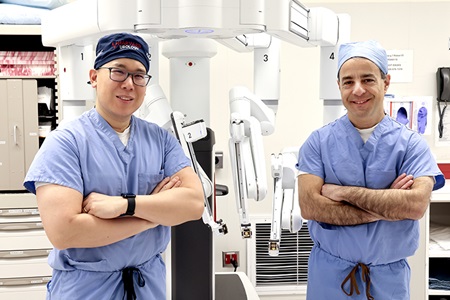
Over the last 10 years, BIDMC has mastered a robotic, minimally invasive version of this procedure. Using the Da Vinci multi-port robot, a surgeon makes six small incisions in the torso, which range from 8-12mm, or just under a half inch.
This approach reduces a patient’s hospital stay significantly, usually limiting it to about one day, and minimizes pain. Certain post-surgery side effects, like compromised bowel function, are also reduced.
Possible Complications of RPLND
At BIDMC, our urologic surgeons are adept at minimizing long-term side effects from RPLND. However, even with robotic surgery, there are still risks of complications like nerve damage. If the nerves in the retroperitoneum are damaged, a patient can experience problems with fertility.
This risk of infertility is consequential, since the average age for initial diagnosis of testicular cancer is 33 years old – an age where many men are trying to start or grow their families.
“The stakes are very high because of the young, healthy nature of these patients, and the technical aspects of the surgery where we’re dissecting off these very large blood vessels,” says Dr. Andrew Wagner, director of minimally invasive urologic surgery at BIDMC and chief of urology at Mount Auburn Hospital.
Patients who are preparing to undergo RPLND are recommended to evaluate sperm banking options prior to surgery.
BIDMC: Center of Excellence in Urologic Cancer Surgery
Our Division of Urologic Surgery is highly trained in treating patients with testicular cancer, prostate cancer, bladder cancer, kidney cancer and other genitourinary malignancies. The expert team of urologic surgeons treats complex, high-risk patients increasingly through robotic and minimally invasive techniques, including single-port surgery performed through one small, ultra-precise incision. The urologic surgery team leads the field in New England and nationally, teaching surgeons at local and national meetings how to perform these innovative surgical approaches.
Surgeons like Drs. Chang and Wagner are also recognized thought leaders, publishing cutting‑edge clinical research that advances robotic surgery, enhances patient quality of life and strengthens multidisciplinary cancer care.
For example, Drs. Chang and Wagner recently served as senior authors on a study that evaluated the use of a preoperative prostate MRI scoring system to determine patients at greater risk of prostate cancer metastasis and recurrence (Bansal et al., 2024). Developing coordinated cancer care between surgery and other cancer care sub-specialties best ensures long-term positive outcomes for patients.
Key Takeaways
Testicular cancer is rare. According to the American Cancer Society, an estimated 9,800 new cases will be diagnosed in 2026. However, it is a cancer that disproportionately affects young men or people born male, remaining the most common solid organ malignancy in men aged 15–35. While the cure rate for testicular cancer is over 95%, it is a disease that can have long-term consequences on quality of life.
Likewise, some testicular cancers can spread rapidly, such as non-seminoma germ cell tumors like embryonal carcinomas, and require swift treatment. "[Testicular cancer] can progress quickly, within weeks,” Dr. Wagner says.
For these reasons, patients with testicular cancer can benefit greatly from advanced health care centers that receive a high volume of urologic oncology cases. At BIDMC, patients who qualify can receive minimally invasive robotic surgery like RPLND to treat and, in certain cases, cure testicular cancer.
To best ensure early detection of testicular cancer, men are encouraged to self-screen and contact their primary care provider immediately if they notice any abnormalities.
As for survivors of testicular cancer and RPLND surgery, it is important to continue receiving care that addresses the full spectrum of patient health, Dr. Einstein notes. As testicular cancer impacts a largely healthy and young population, managing emotional and psychosocial needs is imperative.